Use this Moon Weight Calculator to find your weight on the Moon using the Moon-to-Earth gravity ratio. It can calculate Moon scale equivalent, true weight as force, reverse Earth weight, and constant object mass in multiple units.
A moon weight calculator is a specialized tool that directly answers the question of how much an object or person would weigh on the lunar surface. It estimates this value by applying the Moon-to-Earth gravity ratio to your standard Earth weight. While your physical mass remains completely constant regardless of your location in the universe, your measured weight changes depending on the local gravitational pull.
This calculator allows you to input your current weight or mass and instantly see your moon scale equivalent. You can also use it to reverse the math, converting a known lunar weight back to standard Earth weight. For physics and engineering applications, the tool accurately calculates true weight as force, outputting results in Newtons or pounds-force based on the exact gravitational constants of both environments.
What Is a Moon Weight Calculator?
A moon weight calculator is a digital conversion tool designed to compute the relative difference in gravitational force between Earth and the Moon. At its core, it functions as both a moon gravity calculator and an earth to moon weight calculator.
Rather than requiring you to manually multiply your weight by a string of decimals, the tool handles the standard constants automatically. It supports multiple calculation modes depending on your starting data. You can enter an everyday weight reading to see what a standard bathroom scale would display on the lunar surface.
Alternatively, you can input a strict mass value to determine the actual gravitational force acting upon that mass in both planetary settings.
How to Calculate Weight on the Moon
Understanding how to calculate weight on the moon requires looking at the specific gravitational pull of both bodies. Weight is not a fixed property of an object; it is the physical measurement of gravity pulling on mass.
To determine the difference, a moon weight calculator compares standard Earth gravity against lunar equatorial gravity.
Earth standard gravity is $$g_E = 9.80665\ \text{m/s}^2$$.
Moon surface gravity is approximately $$g_M = 1.624\ \text{m/s}^2$$.
When you divide the Moon’s gravity by Earth’s gravity, you get the fundamental conversion ratio:
$$\frac{g_M}{g_E} \approx 0.1656$$
This ratio explains that moon weight is roughly 16.56% of Earth weight. In everyday terms, this is why educational resources frequently state that you weigh about one-sixth of your normal weight on the Moon.
Moon Weight Formula
A reliable moon weight calculator relies on standardized physics formulas to generate accurate outputs. The core equation for determining any true weight (which is a measure of force) is:
$$F = m g$$
In this equation, $F$ represents force (true weight), $m$ represents the object’s constant mass, and $g$ represents the local acceleration due to gravity.
To find specific true weights as force, the tool uses these exact calculations:
$$\text{Moon True Weight} = m \times g_M$$
$$\text{Earth True Weight} = m \times g_E$$
If you know the force but need to isolate the constant mass of an object, the formula is rearranged:
$$m = \frac{F}{g}$$
However, most people stepping on a scale do not measure their weight in strict Newtons. For everyday unit conversions, the tool calculates proportional scale equivalents.
To find out what a scale would read on the moon based on an Earth weight:
$$\text{Moon Scale Equivalent} = \text{Earth Weight} \times \frac{g_M}{g_E}$$
To reverse the process and find standard Earth weight from a lunar measurement:
$$\text{Earth Weight from Moon Weight} = \text{Moon Weight} \times \frac{g_E}{g_M}$$
Moon Gravity vs Earth Gravity
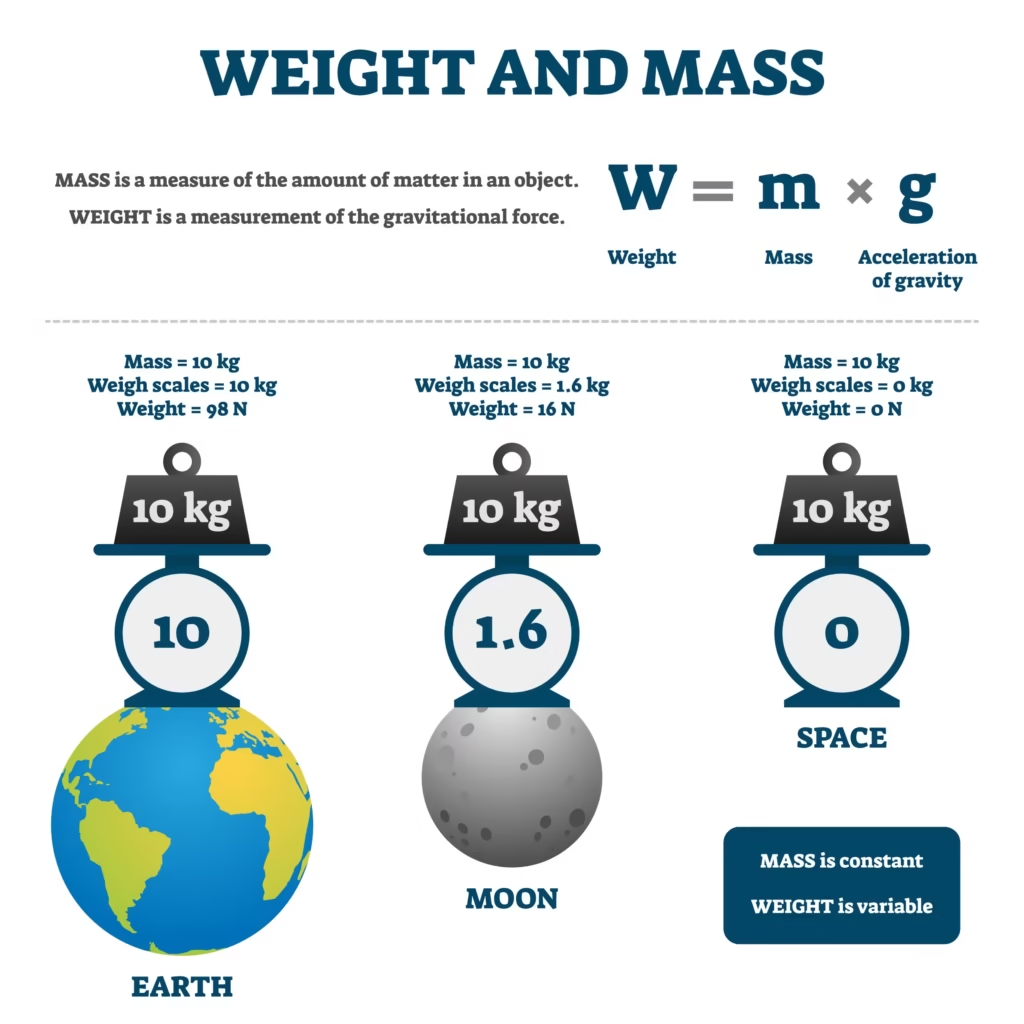
The fundamental reason a weight on moon calculator is necessary comes down to the stark difference between mass and weight. Mass is the total amount of matter in an object. This value never changes, whether you are sitting in your living room or standing in a lunar crater.
Weight is the amount of downward force that gravity exerts on that matter. Because Earth is significantly larger and denser than the Moon, it generates a much stronger gravitational field. Earth pulls down on your mass with an acceleration of 9.80665 m/s².
The Moon, being smaller, only pulls down with an acceleration of 1.624 m/s². Therefore, your mass remains identical, but the force pulling you against the ground drops by over 83%.
How to Use This Moon Weight Calculator
Operating this tool requires selecting your known starting value and allowing the calculator logic to handle the gravitational conversions.
- Select your calculation mode: Choose whether you are converting from Earth weight, converting from Moon weight, or calculating from a known object mass.
- Choose your input unit: The calculator supports lb, kg, oz, g, N, and lbf. Select the unit that matches your starting data.
- Enter your value: Type in the numerical weight or mass.
- Read the generated outputs: Depending on the mode selected, the tool will instantly display the Moon Scale Equivalent, Moon True Weight (Force), Earth Scale Equivalent, Earth True Weight (Force), and the Object Mass (Constant).
Calculate Moon Scale Equivalent from Earth Weight
The most common way people use a moon weight calculator is to convert their everyday weight into a lunar equivalent. This mode assumes your input is a standard reading from an earthly scale, typically expressed in pounds (lb) or kilograms (kg).
When you input this value, the calculator multiplies it by the 0.1656 gravity ratio. The resulting moon scale equivalent represents exactly what a standard, uncalibrated spring scale from Earth would display if you carried it to the lunar surface and stepped on it.
Calculate Earth Weight from Moon Weight
Sometimes physics problems or engineering scenarios require you to work backward. If you are given a lunar weight, you can use the reverse conversion mode to find the Earth equivalent.
Instead of multiplying by the standard ratio, the moon weight calculator multiplies the lunar input by the inverse ratio (Earth gravity divided by Moon gravity). This instantly scales the smaller lunar number back up to standard Earth weight, allowing for accurate comparisons of rover payloads or astronaut equipment.
Calculate Moon and Earth Force from Object Mass
For students and engineers needing strict adherence to physics definitions, everyday “weight” in kilograms is actually a measure of mass. If your starting data is a true mass value, select the mass input mode.
In this mode, the moon weight calculator isolates your constant mass and applies the $F = m g$ formula. It calculates the Earth True Weight and Moon True Weight as distinct forces. The outputs for this mode are naturally displayed in standard units of force, specifically Newtons (N) or pounds-force (lbf).
Moon Scale Equivalent vs Moon True Weight
A high-quality moon weight calculator distinguishes between everyday scale readings and true force. It is critical to understand the difference between these two outputs.
The Moon Scale Equivalent is a proportional translation. It is the conversational answer to queries like “how much would I weigh on the moon” using everyday terms. If you weigh 100 kg on Earth, your moon scale equivalent is roughly 16.56 kg.
The Moon True Weight is the strict measurement of gravitational force. In physics, weight is always a force. If your mass is 100 kg, your Moon true weight is the physical force of the Moon’s gravity acting on that mass, measured at exactly 162.4 Newtons.
Examples of Weight on the Moon
To see how the moon weight calculator processes different inputs, review these three mathematical examples using the exact formulas and constants.
Example 1: Earth Weight to Moon Scale Equivalent
Imagine an astronaut whose equipment weighs 150 lb on Earth. To find the moon scale equivalent, we use the standard conversion formula:
$$\text{Moon Scale Equivalent} = 150 \times \frac{1.624}{9.80665}$$
This equates to $150 \times 0.1656$. The calculator will output a lunar equivalent of approximately 24.84 lb.
Example 2: Moon Weight to Earth Equivalent
Suppose a lunar rock sample weighs 25 lb on the Moon. To find its standard weight back on Earth, we apply the reverse formula:
$$\text{Earth Weight from Moon Weight} = 25 \times \frac{9.80665}{1.624}$$
This translates to $25 \times 6.0385$. The calculator will reveal that the rock weighs approximately 150.96 lb on Earth.
Example 3: Object Mass to True Weight (Force)
If a scientific instrument has a verified mass of 70 kg, we calculate the true force exerted on it by both bodies.
For Earth True Weight:
$$F = 70 \times 9.80665$$
The Earth force is 686.46 N.
For Moon True Weight:
$$F = 70 \times 1.624$$
The Moon force is 113.68 N.
Common Unit Conversions in a Moon Weight Calculator
A comprehensive moon weight calculator handles multiple units to accommodate both casual curiosity and strict scientific calculations.
- Pounds (lb) and Ounces (oz): Common imperial units used for everyday scale equivalents.
- Kilograms (kg) and Grams (g): Common metric units. While technically units of mass, they are universally used as scale equivalents in everyday language.
- Newtons (N): The standard metric unit of force used for representing true weight in physics.
- Pounds-force (lbf): The imperial unit of force, used to distinguish true physical force from standard mass in engineering scenarios.
When to Use a Moon Weight Calculator
This calculator serves a variety of practical and educational purposes. Science teachers use it to clearly demonstrate the difference between mass and force in the classroom. Engineering students rely on the mass-to-force modes to calculate the structural load of payloads intended for lunar missions. Additionally, it is a fast, reliable tool for anyone searching out of pure curiosity to find their exact lunar equivalent without doing the manual math.
Limitations and Assumptions
While highly accurate, this moon weight calculator relies on standardized constants. It uses standard standard Earth gravity ($9.80665\ \text{m/s}^2$) and standard Moon equatorial gravity ($1.624\ \text{m/s}^2$).
In reality, gravity is not perfectly uniform. Earth’s gravity varies slightly depending on your elevation and latitude. Similarly, the Moon’s gravity contains anomalies and varies slightly across its surface. For the purposes of conversion, scale equivalents, and general physics equations, these minor local variations are intentionally ignored to provide a consistent standard baseline.
FAQs
How much would I weigh on the moon?
To find your exact lunar weight, multiply your current Earth weight by 0.1656. For example, a person weighing 150 lb on Earth would have a moon scale equivalent of roughly 24.84 lb.
What is the formula for moon weight?
If you are looking for true physical force, the formula is $\text{Moon True Weight} = m \times g_M$ (where $g_M = 1.624\ \text{m/s}^2$). If you are calculating an everyday scale equivalent, the formula is $\text{Earth Weight} \times \frac{g_M}{g_E}$.
Is moon weight one sixth of earth weight?
Yes, roughly. The exact ratio of Moon gravity to Earth gravity is approximately 0.1656, which translates to 16.56%. This is very close to 16.66%, which is exactly one-sixth.
Does mass change on the moon?
No. Your mass is the total amount of physical matter that makes up your body. That amount remains completely constant regardless of your location. Only the gravitational pull acting on that mass changes.
How do you convert earth weight to moon weight?
You can convert it manually by multiplying your Earth weight by the Moon-to-Earth gravity ratio (1.624 divided by 9.80665). Using a moon weight calculator automates this step instantly for any unit.
What is moon gravity in m/s²?
Standard lunar surface gravity at the equator is accepted as $1.624\ \text{m/s}^2$. The calculator uses this exact constant to generate force and scale conversions.
Can I use pounds or kilograms in a moon weight calculator?
Yes. The tool accepts pounds, kilograms, ounces, and grams to calculate standard scale equivalents. It also accepts strict mass inputs to output true force in Newtons or pounds-force.
What is the difference between moon scale equivalent and moon true weight?
The moon scale equivalent is what an Earth bathroom scale would display if you stepped on it while on the Moon (measured in lb or kg). Moon true weight is the strict physics calculation of the actual gravitational force acting on your body, measured in Newtons or pounds-force.
Related Tools & Calculators: